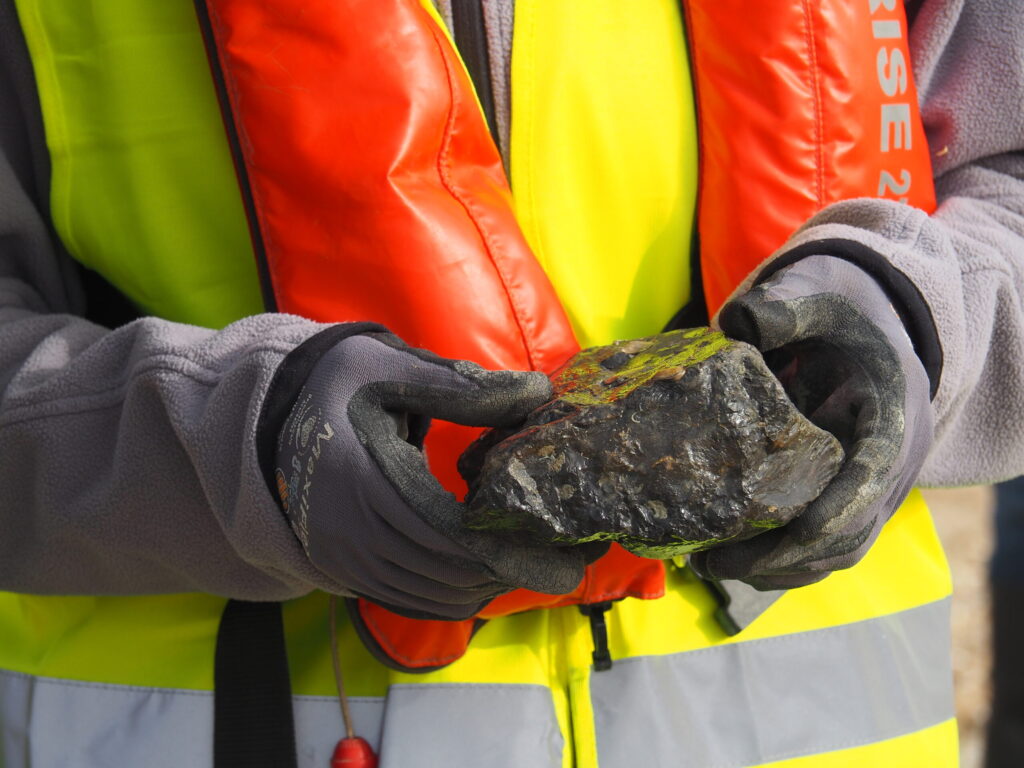
Last summer, stones with young flat oysters were deployed in the Port of Rotterdam for the first time. These had been “seeded” with oyster larvae using an innovative technique known as remote setting. After being cultivated in a specialized hatchery, the oyster larvae were transported to a location near the sea. There, modular containers – designed for flexible use at different sites – were prepared. Inside these large seawater-filled containers, the larvae attached themselves to stones within a few days. The stones with oysters were then deployed. Recently, researchers returned for the first time to assess how many oysters had survived the first few months.
“The findings after further analysis are actually very positive,” says Pauline Kamermans, a marine ecologist at Wageningen Marine Research. She leads the so-called RESO project, in which nine partners collaborate. “The survival rate turns out to be comparable to other reef restoration projects in the region. With the number of live oysters we found, we more than meet the internationally recognized definition of an oyster bed.” However, according to Kamermans, this does not yet mean there is a reef. “A reef is more than an oyster bed: it has a higher density of oysters per square meter that reproduce and grow on top of each other’s shells.”
Towards better results
The results of the first monitoring provide insights into where improvements can be made. Many of the dead oysters showed little to no growth since the day they were deployed. It is possible they did not survive the transport or the placement on the seabed. “Last year was the very first time we applied this method – remote setting with European flat oysters on stones – in practice,” Kamermans explains. “That is precisely why this monitoring was so valuable. The results give us clear leads on where we can improve.”
The partners will, among other things, improve monitoring of the factors influencing how oyster larvae settle on the stones, for example by tracking temperature and food supply more closely. By increasing the number of young oysters on the stones, the partners also hope to keep more of them alive in the North Sea. They are also exploring ways to adjust the transport and deployment processes to improve survival rates. The next deployment of “oyster stones” will take place later this year at two TenneT cable crossings, further offshore.
Restoring life to the North Sea
The partners are working on this reef restoration method because reefs are crucial for life in the North Sea but are now extremely rare. Oysters build these reefs, making them one of the richest ecosystems in the North Sea. Reefs provide shelter, habitat, feeding grounds, and breeding areas for various fish species, seaweeds, rays, and even seals and small cetaceans. In addition, reefs improve water quality.
With the development of remote setting on stones, a consortium is exploring how reef restoration can be smartly linked to the construction of maritime infrastructure such as wind farms and cable connections. The containers have been adapted to meet offshore industry standards. By allowing oysters to settle directly onto stones and then deploying them in areas where hard substrate is needed, the partners aim to bring large-scale nature restoration one step closer.
Joining forces
Nine companies, knowledge institutes, and nature organizations are collaborating in the pilot for remote setting (the RESO project): Wageningen Marine Research, Wageningen University, ARK Rewilding Netherlands, Stichting Zeeschelp, Waardenburg Ecology, Van Oord Ocean Health, TenneT, the Port of Rotterdam Authority, and The Rich North Sea. The Rich North Sea is a collaboration between Stichting De Noordzee and Natuur & Milieu.