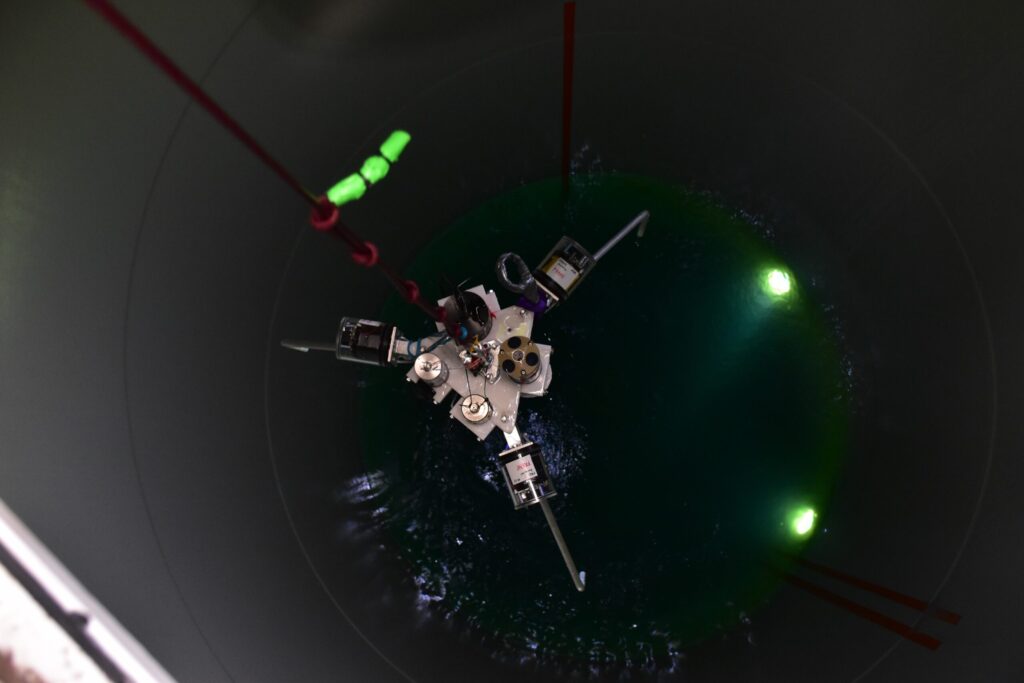
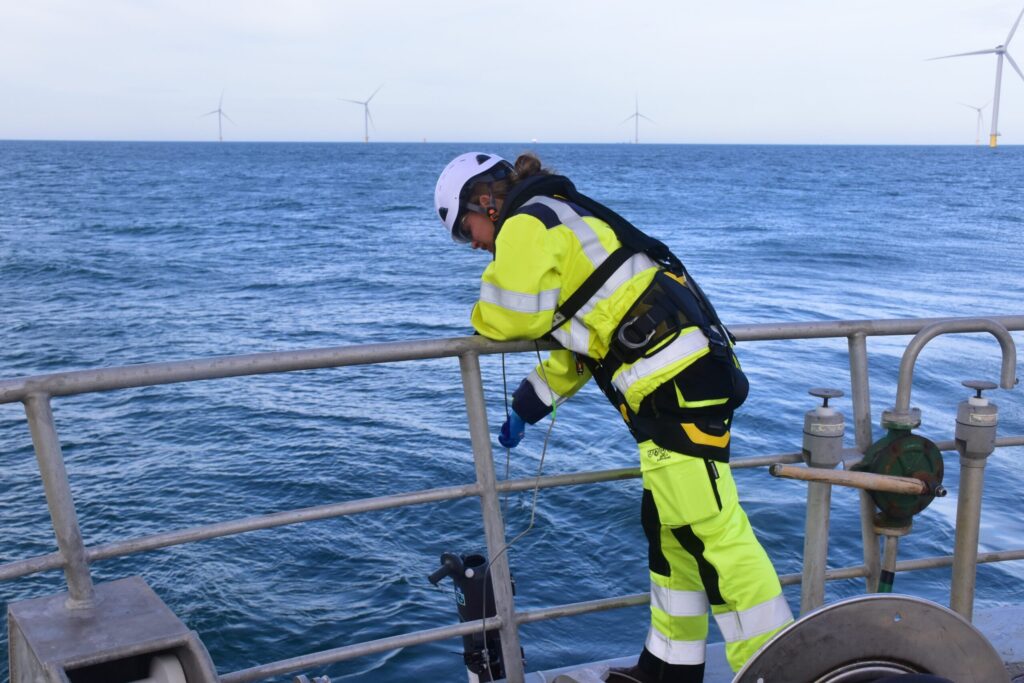
The research was conducted as part of the JIP-LIFE consortium, a collaboration exploring the ecological effects of water replenishment holes in turbine foundations at the Hollandse Kust Zuid offshore wind farm. Researchers studied water quality parameters and species communities inside and outside the foundations through combined video footage, eDNA analyses (DNA traces in water), water quality measurements and computer models of water exchange inside the monopiles. For the study, data were collected from five monopiles during multiple offshore campaigns in 2024.
The outside surface of the foundations was largely covered by mussels, anemones and other typical species living on hard structures in the North Sea. Inside, researchers observed, among others, sponges, tunicates, brittle stars and tube-building worms. The growth on the inside was more varied and less dense than on the outside. “The inside of these monopiles forms a relatively dark and sheltered environment with different ecological conditions from those on the outside,” says Lea Kornau, PhD researcher at Wageningen Marine Research. “As a result, different communities have developed there, due to factors such as water exchange, oxygen availability and food supply.”
Researchers also observed microbial mats on the seafloor inside the monopiles. These possibly indicate local limited oxygen availability and highlight the importance of further research into the ecological functioning of these foundations and opportunities to improve future foundation designs.
The role of water replenishment holes
The water replenishment holes were originally designed for technical reasons, allowing for sufficient water exchange to fit additional anti-corrosion measures if required in the future. The availability of oxygen and food inside the monopiles depends on water exchange through these openings. The study shows that design parameters such as hole size or orientation can influence water quality inside the monopiles and, in turn, species communities.
The project provides a first knowledge base for better understanding how water exchange, water quality and ecological processes within monopiles are interconnected. The results may contribute to future design considerations for water replenishment holes in offshore wind turbine foundations, including discussions on nature-inclusive design, and advance knowledge on ecological interactions with offshore infrastructure in the North Sea.
At the same time, the researchers point to the importance of continued monitoring to better assess the long-term development of these communities, including the possible establishment of non-native species.
“Water replenishment holes contribute to the lifespan of wind turbines, and their design can be adjusted to support certain natural communities. This wonderful outcome highlights the potential for offshore wind design to contribute to nature restoration ambitions,” says Vera Bánki, Program Director here at The Rich North Sea.
“As offshore wind expands, it becomes increasingly important to understand how these novel structures interact with marine ecosystems,” says Tim Wilms, Bioscience Expert at Vattenfall. “This study shows that even the internal space of turbine foundations can become a habitat for many species, but that we need to carefully consider the design of our foundations to create favorable ecological conditions.”
The results are described in the final report of the JIP-LIFE project, carried out by Deltares, Wageningen Marine Research, Stichting De Noordzee, Seaward and Vattenfall, and us. The project is funded by Topsector Offshore Energy.
A related scientific preprint led by PhD researcher Lea Kornau of Wageningen Marine Research was recently published, providing a more detailed ecological analysis of the species communities developing inside monopiles.