News
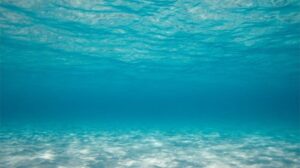
Research into the seabed in the North Sea
A breakthrough from The Rich North Sea in collaboration with TU Delft. Using existing data, we have located spots with harder sediments within the offshore area Hollandse Kust Zuid and Borssele. These spots possibly refer to the presence of biogenic reefs (structure of skeletons of plant or animal species). Now we can investigate these spots directly, which increases the chance of success and is more efficient.
Read more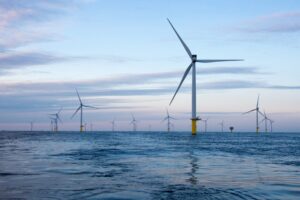
Prof. Tinka Murk (Wageningen University Research) on North Sea changes and future prospects
In the NPO radio show Focus, toxicologist and professor of marine ecology at Wageningen University Tinka Murk was interviewed about how the North Sea has changed over the past decades and her perspective on the future.
Read more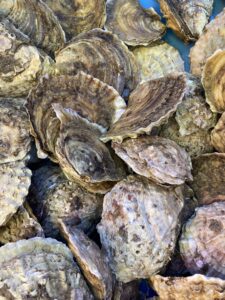
Life cycle of European flat oysters
An introduction on the life cycle of European flat oysters has been written that specifically addresses the methods that predict spawning time.
Read more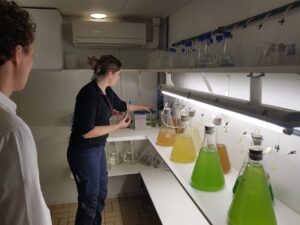
The start of The Rich North Sea oyster breeding programme
A sample taken from the Zeeland breeding grounds found that 65% of the oysters were free of the Bonamia parasite.
Read more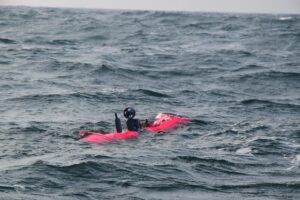
The Rich North Sea starts with Offshore Test Site
The "Offshore Test Site" of The Rich North Sea consists of various test locations where we try-out our work for wind farms on a small scale. This gives us good insights into what works best at sea and we will soon reap the benefits of this when we start working directly in wind farms in the North Sea.
Read more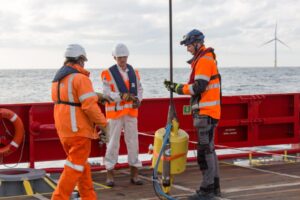
Pilot project in wind farm Luchterduinen shows promising results
In the Luchterduinen wind farm, the first pilot project of the Rich North Sea commenced in 2018. The aim of the project is to identify the factors influencing the success of nature restoration using oysters and to contribute to a blueprint for the possibilities of nature enhancement in wind farms in the North Sea. In July 2019, a monitoring mission was carried out on this project, on the basis of which a research report was drawn up in collaboration with Wageningen University & Research.
Read more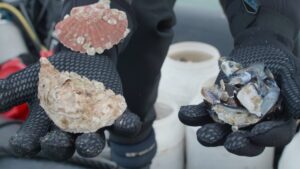
Dutch cultivated flat oysters released into the sea
The Rich North Sea has started cultivating flat oysters together with a group of experts. Flat oysters are hardly found in the Dutch North Sea anymore. Last summer, the breeding line produced the first healthy flat oysters. This winter, 30,000 young oysters, the so-called oyster spat, were released in Zeeland's Voordelta. Erwin Coolen, program director of The Rich North Sea: ‘Growing flat oysters is difficult, so we are extremely pleased that we succeeded. The return of oyster beds to the North Sea is another step forward.’
Read more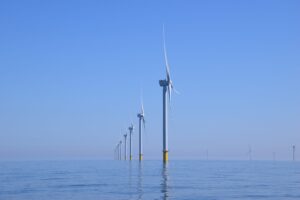
Options for biodiversity enhancement in offshore wind farms
Commissioned by The Rich North Sea, researchers from Bureau Waardenburg drew up an overview of nature-enhancing measures in wind farms. They mapped out which species are suitable for nature enhancement, the properties of the seabed and the presence of nutrients. By combining these factors, they made an overview of the most promising nature-enhancing measures. They did this for all planned wind farms in the North Sea until 2023.
Read more